Back when I lived in England as a teacher before I was married, I wrote a set of haiku. If you are not familiar with this type of Japanese poetry, it is only three lines, with five, seven, and five syllables. Haiku are usually about nature, and sensory details are used to bring out a moment frozen in time. Here are the haiku I wrote about England:
Half-timbered houses
Thatched cottages with roses
Crawling up old walls
Lazy afternoons
Sip cream tea and savor scones
At an old tea shoppe
Cathedral bells chime
Beckoning men and women
To draw near to God
Castles by the sea
Breathtaking in their beauty
Capture sighing hearts
Here you are with me
Among the valley’s flowers
And I feel at home
“I am the vine, you are the branches; he who abides in Me and I in him, he bears much fruit, for apart from Me you can do nothing.” John 15:5 NASB
I am a branch connected to Christ, and the Holy Spirit flows through me like sap, energizing me to produce fruit. As a branch, I am not the root; I am completely dependent upon Christ to draw strength. All water and nutrients come through the roots, so if I do not allow the Holy Spirit to control me and pump me with fresh nutrients each day from His Word, I will shrivel up and die. Jesus says, “If anyone does not abide in Me, he is thrown away as a branch and dries up; and they gather them, and cast them into the fire and they are burned.” (John 15:6) What I’m doing with my life is worthless if I am not connected to the Vine.
The only reason I am allowed to share in the life of the Vine is to produce fruit.
Bearing fruit (glorifying God in our actions, being sanctified, and becoming more like Christ) is what we’re saved for. Jesus says: “My Father is glorified by this, that you bear much fruit, and so prove to be My disciples.” If we are true disciples we will bear fruit. (James 2:17)
You bear fruit not for yourself, but for your owner. The Father owns the vine and prunes the branches to produce more fruit. Anything that is not needful for fruit-bearing must be lopped off. Better fruit results when the vine is tended to by the owner. The branch is more beautiful, fruitful, and healthy.
“If you abide in Me, and My words abide in you, ask whatever you wish, and it will be done for you.” (John 15:7) We have incredible power for answered prayer if our will is yielded to God, because He grants us the desires of our hearts. “Delight yourself in the LORD; And He will give you the desires of your heart.” (Psalm 37:4) That’s because your will and God’s will are the same. It’s aligning your heart to God’s heart. And then you are one. This is why your prayers are answered. God changes your desire and then grants you that desire because you yielded.
“The vine provides the sap, the life, and the strength. The branch waits, rests, receives, and bears the fruit.” -Andrew Murray in The True Vine: Meditations
“Abiding fully means praying much,” says Andrew Murray. We will care about the souls of others and be given up to the work of God when we are abiding. As a result, we will be people of prayer.
Andrew Murray goes on to say: “The branch is not only one with the vine, but with all its other branches.” The sap running through the vine is the love of God. When you are connected, you will abide in that love. People that do not love do not know God. God is love. The biggest difference in the life of a believer after salvation is the ability to love. Do not hate your brother.
“These things I have spoken to you so that My joy may be in you, and that your joy may be made full.” (John 15:11) Andrew Murray says: “As long as our joy is not full, it is a sign that we do not yet know our heavenly vine correctly.”
Abiding in the Vine will give you power in prayer as well as incredible joy, and you will bear fruit that is pleasing to the Father.
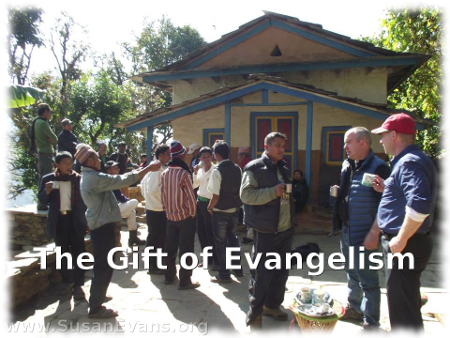
All believers are commanded to evangelize, or to lead other people to Christ, but there are some people with the gift of evangelism who seem to win souls wherever they are. They have a deep burden to fulfill the great commission to “make disciples.” Billy Graham, Chinese Brother Yun, Corrie Ten Boom, my own father, and a man from my church who recently went to be with the Lord are a few examples that come to mind.
My dad worked for Billy Graham before he became a missionary in Guatemala. Imagine the joy of easily leading people to Christ when they had already been convicted of their sin by Billy Graham. Droves of people would come down the aisle, ready to be saved, and my dad was one of the workers who prayed one-on-one with those people. He felt so much joy that he wanted to continue to do that for the rest of his life, he told me.
I recently read the sequel to The Hiding Place, by Corrie Ten Boom, a survivor of the holocaust. God would call her to different cities where she didn’t even know a single person. She would walk out of the airport and look around, asking God who she was supposed to talk to. She ended up doing speaking engagements all over the world, leading people to Christ in the process. She confessed that it was wearisome to live life out of a suitcase, but she was scared of living outside the will of God because she needed to be connected to the Spirit of Christ. Being effective and useful for God’s kingdom gives so much joy that once you have experienced it, you never want to live without it.
Chinese Brother Yun (The Heavenly Man) was the same way. He was led all over China, spreading the gospel to anyone who would hear. He suffered great persecution as part of the underground church, and he was thrown into prison and beaten multiple times. But he had this huge desire to share the gospel with the lost, and he was a powerful modern-day evangelist. God has worked miracles around him, like setting him free from prison, blocking the guards from seeing him walk straight out of the prison. There is documentation to show that this happened. God is extraordinarily good to those who are wholeheartedly His.
Danny Acosta was a member of my church who recently went to be with the Lord. He was abruptly given three days to live. But he led ten prisoners to Christ during his life, as well as many other people. There is one woman from the street in particular that God has given me a deep love for, who was led to Christ by this man. She describes how he would boldly greet a hardened gang member as he walked down the street. She laughed at how much courage he had, because normal people thought his boldness was crazy. But the Spirit of the Lord rested upon this man, and the gang member awkwardly said thank you to this man’s greeting! My jaw dropped the first time I heard this man pray. He claimed promises from Scripture as he prayed, and his strong faith was not misplaced. Even though I never really knew him, I grieved when he passed away.
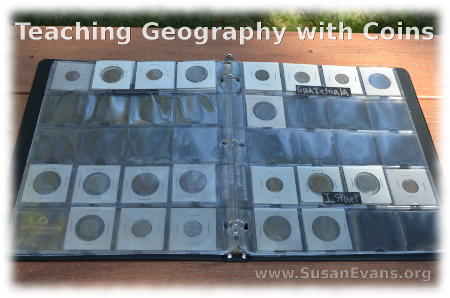
A fun way for kids to learn about the countries of the world is to look at coins from other countries and start their own coin collections. Teaching geography with coins is a great way to touch something from another country and to figure out what is important to that country.
Where can you find coins for your children?
From your own travels to different countries
From relatives or friends who have been to other countries
From people at your church who have returned from missions trips
From other homeschoolers who can swap coins with you
From coin collecting shops
How do you start a coin collection? First you will need a 3-ring binder. Next you will want to purchase coin collecting pages, which are plastic pages with 20 square pouches on each page. You can buy these at a coin collecting shop. Look up “coin collecting” in your local yellow pages, or google “coin collecting” and your city. Most cities have a coin collecting store.
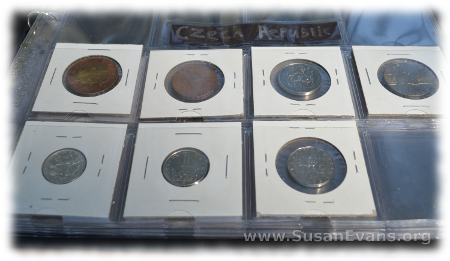
Besides the binder and the plastic pages with pouches, you will want to get the cardboard squares that will hold the coin in place. You staple those shut with a special stapler that is smooth on both sides so that it doesn’t hurt the plastic. Label the countries with little slips of paper taped to the plastic sheets.
If you are dirt poor and don’t want to spend any money whatsoever, you can collect loose coins in a clear Ziplock bag to look at whenever you want. You can do rubbings of the coins by placing the coins under a sheet of paper, and rubbing crayon across the top. You can staple your coin rubbings together into a booklet. This is particularly good to do if you are only borrowing the coins from someone, and you need to give the coins back.
What can you learn from countries by looking at coins? These are some of the emblems we found on our coins from around the world, showing what is important to each country. These pictures might help you identify where your coins are from:
Canada–maple leaf, queen
Egypt–scorpion, map of Africa
France–woman in a dress, head of a woman
Germany–head of a man, woman planting, eagle
Greece–helmet of armor on a man, Parthenon
Guatemala–woman’s head with headband, tree, man’s head, stone monument, quetzal bird
Ireland–harp, bull, Celtic design
Israel–Dome of the Rock, top of a column, golden lampstand, fleur-de-lis, harp
Italy–woman’s head, Roman gods and goddesses
Mexico–eagle with snake in beak
Netherlands–crown, queen
Spain–men’s heads, shield, pillars, crown
United Kingdom–one king, all the rest queens, portcullis, crown, chains, Poseidon with trident, coat of arms, ship, lion with crown
These were just a few of the observations my children called out to me as they were examining the coins from their coin collections. Teaching geography with coins was a fun experience for my family!
Hi! I'm Susan Evans. I speak at homeschool conferences about hands-on learning and run a huge unit study membership site. I also speak at women's retreats on the topic of prayer.
I am an affiliate for Bright Ideas Press, Ultimate Homeschool Expo, and Amazon. I also do reviews for iHomeschool Network. If you buy through my links, I get part of the money. I give 10% of my website profits to missions.
Become my Affiliate
If you would like to sell my products and earn 50% commission, go here.
 Back when I lived in England as a teacher before I was married, I wrote a set of haiku. If you are not familiar with this type of Japanese poetry, it is only three lines, with five, seven, and five syllables. Haiku are usually about nature, and sensory details are used to bring out a moment frozen in time. Here are the haiku I wrote about England: