Charlotte Mason – Book 2: Parents and Children

April 20th, 2012

Charlotte-Mason-Book-2

In this book Charlotte Mason explains to parents how they should teach their children. The most important aspect in the teaching of children is the formation of their character. Character can be taught through the formation of habits. To erase a bad habit, replace it with a good one. For example, if a boy is constantly playing bad tricks on people, excite him with the idea of bringing joy and good surprises to those people. Then devote yourself for a month to the child, making sure that he never falls into his old habits.

Most of what we do in life is done through habit. If we want to improve our lives, we must build good habits into it, one at a time. Then we will mindlessly do the good habit that brings joy to our lives. Well brought-up children are the ones that have been trained to have good habits.

We must also give our children living ideas every day – something that will excite them and deepen their curiosity, and therefore their knowledge of the world. This can be conveyed through nature, living books, the Bible, or an everyday object around the house. Children have a thirst for knowledge, and a day is wasted if it does not have one new idea for them to think about.

Humility is a character quality that we as a society do not understand. We think it means that we put ourselves down and say that we are not good at something. But Christ never put Himself down, and He is our example of perfect humility. To be humble means to not think of oneself at all. We should try to instill this quality in our children. (Charlotte Mason says that children are humble naturally, but I disagree.)

Truthfulness is also important. If a child is not accurate, but embellishes by making up much of the story of what happened, we are to make sure that the child understands the difference between truth and fiction. The child needs plenty of time to play in the fictitious world by reading fairy tales or playing at King Arthur, for example. But then show the difference between truth and fiction, and tell them that when addressing adults about real life, they should stick to the facts.

As far as blatant lying is concerned, we should get to the underlying issue. If they are trying to defend someone else, tell them that defending someone is good, but not at the expense of truth.

Even a baby can be trained in character. If he cries, change his thoughts to something new, like going outside or smelling a flower. Then the habit is set up to not cry for every simple bump in life. Instead he finds something else to interest him, and he takes his mind off the pain.

People sometimes misinterpret logical conclusions as what is morally right. The mind will fix upon an idea and subconsciously follow it to its logical conclusion. This is why people can rationalize sin – it seems like the right thing to do. Only if we are aware that our mind runs subconsciously along a logical course can we stop and throw out those thoughts that are wrong.

This book restates many of the same issues covered in volume one, but it comes at them from different angles, which is useful for understanding the topics that she is dealing with.

Related product: Using Journals to Teach Writing

Charlotte Mason – Book 1: Home Education

April 19th, 2012

Charlotte-Mason-book-1

Charlotte Mason feels that it is important for children to be outdoors four to six hours a day. The fresh air and sunshine are good for their physical health as well as their mental health. Powers of observation can be developed in the child as he describes in detail a scene that lies before him. The oral narrations (verbal descriptions in this case) lead to good written narrations later. The child can observe insects and other wild animals, which are all part of larger classifications. The child’s familiarity with nature will help him to understand literature and the world in general. A piece of dry ground can serve as an example of the Sahara Desert.

Famous artwork can be viewed in the same way as the outdoor observations. The child can describe a painting in detail, and then it becomes “theirs;” in other words, they remember it.

Keep lessons varied and short (10 or 15 minutes for children under 9.) This way the child’s mind is fresh and can concentrate well. Reading lessons should consist of one lesson of word building, and the next lesson (the next day) on sentence building. She stresses sight reading as the easiest way to learn reading. She says that spelling is visual, and that the child should photograph each word in his mind in order to always spell the word correctly.

Foreign language should be taught every day in such a way that the young child is submerged in the language. This way the grammatical aspects of the language get absorbed easily and effortlessly. The child can be taught foreign language outdoors.

Habits are extremely important to form in the child, even from an early age. The habits of obedience and self-control are the most important, because from them you will be able to teach your child anything. Self-control is having authority of your own will, being able to force yourself to do something that you don’t want to do, because doing it is the right thing, and you want the positive results. For example, I forced myself to pull weeds in the yard, and now the yard is beautiful, and I can enjoy it more. The end results must be kept in mind, especially when you are initially learning self-control.

Habits can also make our lives much easier. To form a new habit, you must force yourself to do the new action over and over again. At first it is hard, but then it becomes effortless. For example, my morning routine includes starting a load of laundry first thing in the morning. Now I do it automatically, and I’m never behind on my laundry. This is one of the positive aspects of having some kind of schedule, because children will be automatically going from one set of studies to another. Even with small children, they are able to concentrate and be well-behaved if you have a schedule. When I was in the hospital giving birth to my third baby, there was no schedule followed for my two toddlers at home. As a result, they threw tantrums the entire day. They were probably exhausted from making decisions, instead of going through one scheduled activity to another in their familiar order. As soon as order was brought back to their day, the tantrums disappeared.

For Bible lessons, Charlotte Mason would like us to read Scripture to the children and not water it down with morals to each story. When children see the consequences of sin or obedience, which are obvious from each story, they will want to be obedient to receive blessing from God.

We must teach our children about God; but how, besides teaching God’s Word? We must teach them what we know is true about God. For example, I know that God is a God of comfort because in my times of deepest anguish, God has given me the peace that passes understanding. Whatever you have experienced in your walk with God, share it with your children. They will believe whatever you live out in your life.

Related product: Using Journals to Teach Writing

Spring Activities for Homeschoolers (free PDF)

April 18th, 2012

spring-activities-for-homeschoolers-2

Here is a fun list of 24 spring activities for homeschoolers, including a free PDF, in case you want to check them off as you do them with your kids!

  1. Take homeschooling outside: sit on a blanket and read your history lesson or a great work of literature on a blanket in the backyard. Grab a picnic and take it to your tree house or fort, and read your lesson up there.
  2. Skip forward in your science book to a chapter on plants, insects, or other outdoor topic.
  3. Do a short unit study on butterflies. Watch caterpillars turn into butterflies, and do drawings of butterflies with the correct markings.
  4. Create a beautiful nature journal. (See Using Journals to Teach Writing downloadable DVD workshop on my website for complete details.)
  5. Gardening. Plant a flower garden, vegetable garden, or herb garden. Make your backyard into an oasis. Have older children map out a landscape plan of where each plant should go. Research shade vs. sun plants. Look through gardening books for inspiration.
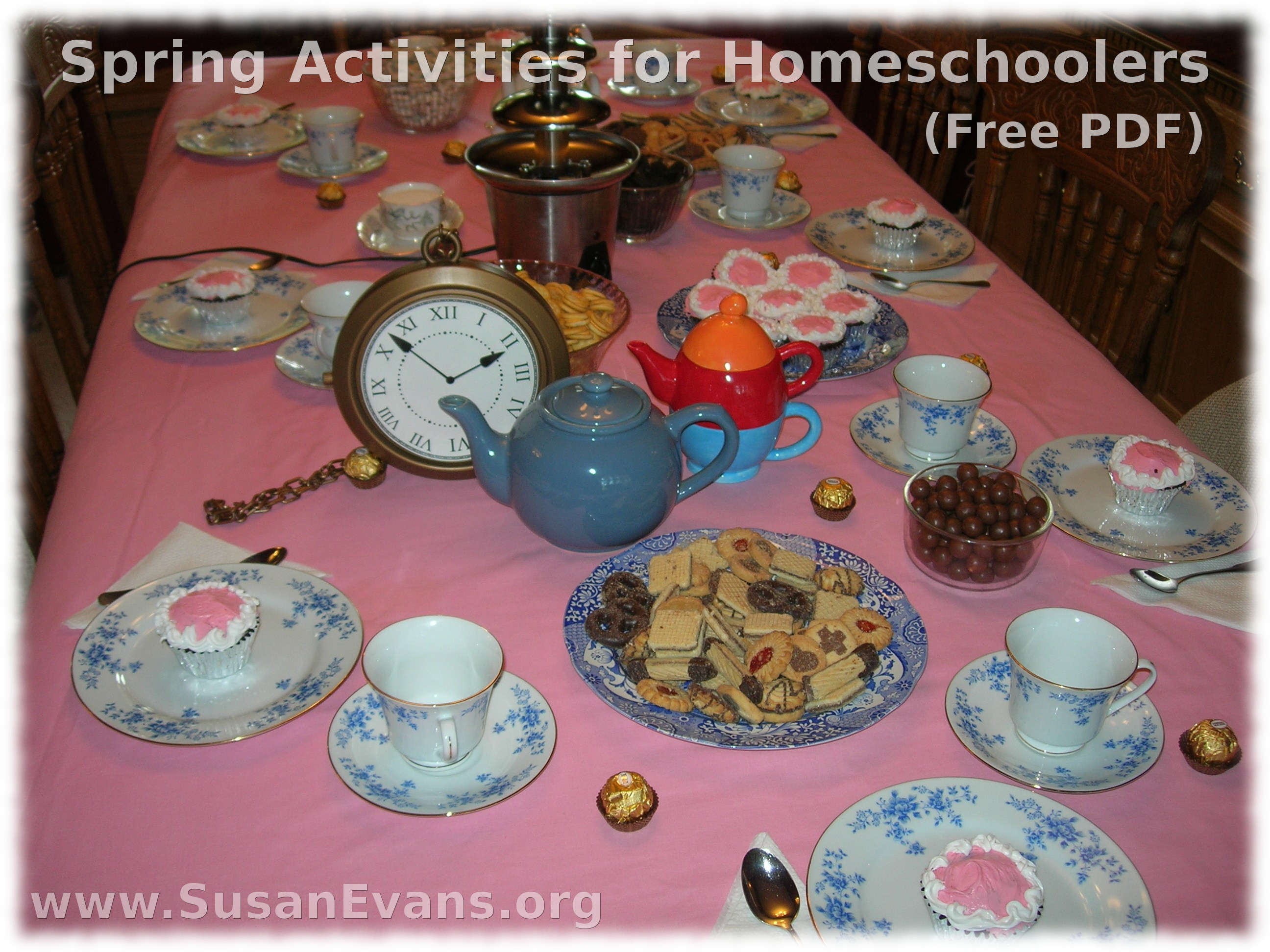
  6. Plan a tea party. It can be as simple as a pot of chamomile tea and imaginary food. Or go all out and invite people, dress up with fancy hats and boas, and make lots of tasty finger foods. Put fresh flowers on the tables.
  7. Visit a botanical garden. Look for signs of spring. Capture the wonder of spring on video or photography. (Watch The Wonder of Spring on my YouTube channel for fun ideas on how to do this.)
  8. Go fishing on a nearby lake. Your child can spend one-on-one time with Dad.
  9. Fly a kite. Make sure it’s a windy day. You can make your own or buy one.
  10. Climb trees. Ones with branches close to the ground are easier to climb, especially if there are branches spiraling out like a ladder. Oak trees are the best climbing trees.
  11. Bird watching. Put out bird houses and bird feeders. Find a bird enthusiast and ask him where the nearby bird sanctuaries are. Take binoculars and a field guide. Study bird calls.
  12. Feed the ducks on a nearby river or lake. Get really close to the birds and notice their markings. Read Make Way for Ducklings and other books about ducks.
  13. Hatch an egg. You can buy a $20 incubator, and borrow 3 eggs from a nearby farmer. Rotate the eggs twice a day, and watch a chick hatch out of an egg. Then give the chick back to the farmer.
  14. Make a nature centerpiece for your table. Go on a nature hike, collecting items from nature. Come home and arrange them in a beautiful way on your table.
  15. Blow bubbles. You can make huge bubbles if you use glycerin. There are many activities you can do with bubbles, which I mention in my “Bubbles unit Study” article on my website. I also have the best bubble recipe in that article.
  16. Nature Hunt for Colors. Cut off the top part of an egg carton, and have a young child paint each hole a different color from nature. Then go on a nature walk, and have your young child find nature items to match each color.
  17. Explore local parks. Look on a map, and you will find lots of parks in your area. Go explore them all and choose a favorite.
  18. Outdoor painting on an easel. Younger kids can use tempera paint. Older kids can paint with oil paints on canvas, or with watercolors on watercolor paper.
  19. Study frogs. Watch a tadpole turn into a frog. Do frog crafts, read books on frogs, and watch DVD’s about frogs. (Unit Studies are great!)
  20. Write some original spring poetry. For inspiration, read classic poetry like Wordsworth’s “I Wandered Lonely as a Cloud,” which talks about golden daffodils in the spring. Listen to Vivaldi’s Four Seasons: Spring to get into the mood of the season.
  21. Make a spring lapbook, especially if you have young children. I show you how to do that on my website, in the article on “Lapbooks.”
  22. Start an insect collection, either of live insects in terrariums and jars, or dead insects in a traditional insect collection. Observe insects with a magnifying glass.
  23. Grow indoor grass, herbs, or terrariums. If you choose carnivorous plants like Venus Flytraps, make sure there is humidity, which requires a lid on the jar or a terrarium cover.
  24. Do a spring treasure hunt. List 10 things for your children to find in your backyard. For example, find a lady bug, dig up a worm, find ants under a rock.

If you would like to print out this list, here is the PDF:
Spring Activities for Homeschoolers

I Don’t Mind the Snoring

April 17th, 2012

snoringDuring the first few years of my marriage, I was annoyed whenever my husband started snoring. I sat up, looked at him, and carefully tried to turn him over so that he would stop. This happened only when he was suffering from allergies. Normally he didn’t snore. He just breathed hard.

Now that I’ve been married almost 15 years, I love to hear my husband snoring. It’s relaxing to me. First off, it means that my husband is with me. Sometimes he travels on business, and when he’s gone, I can’t sleep very well because he’s not in bed, and I feel like something is missing. Secondly, my husband has sleep problems (please pray for him; he has had sleep problems for almost 3 years and feels haggard nearly all the time, and I want so desperately for him to sleep). So when I hear my husband snoring, I smile and I’m so happy and peaceful that I fall asleep. I actually like to hear him snore.

During this past winter, I’ve gotten flus and colds, one after another. One night I heard my husband finally start to snore after midnight. I was so happy that I smiled, but then suddenly I felt a tickle in the back of my throat, because I had to cough. I tried so hard not to cough, but I involuntarily let out a cough. My husband stopped storing. I was so disappointed that my cough woke him up…

It’s like this with other aspects in my marriage. The idiosyncracies of my husband have become dear to me. Little things that used to annoy me no longer do. Maybe I’ve just gained perspective on life, on what’s important and what isn’t. Or maybe I’ve let love cover it.

It reminds me of the old movie “Annie,” where the main male character falls in love with a woman, only to tell her that her teeth were crooked. She felt self-conscious for a minute, but then he declared that he loved crooked teeth. He loved her teeth because they were hers. When deficiencies are no longer seen as liabilities, people can feel more restful and secure, knowing that they are accepted for who they are.