That’s What God is For

October 4th, 2012

For children to bicker and not get along is the natural human condition. That’s why we need transformation. That’s why we have God. God is able to do what we are not. In our own strength, nothing supernatural is possible. With God, I’ve seen miracles happen on a weekly basis in my home. The majority of those miracles happen inside my own heart as I lean on God. Yes, you have to have a desperation that causes you to throw your entire being upon God for Him to work.

The other day my kids were screaming at each other. I took one of my sons involved in the screaming to another room. Perspective. That’s what I said. He was talking in such a frantic manner, as if playing a game was an emergency. Peace and a yielding to God should rule our hearts, not this frantic screaming and demanding one’s own way. He said his brother was annoying him. (I have already addressed the fact that annoying others is like Satan because it causes someone else to sin, so it’s worse evil than the person who strikes back in self-defense.) But now I’m dealing with the one who strikes back, or in his screaming words he was attempting to strike back. I said, remember Jesus was insulted and struck, but He did not retaliate. My son said, “But that’s impossible.” His brother makes him so furious.

“Sweetheart, of course it’s impossible. That’s what God is for. Our God is the God of the impossible. God changes me all the time in ways that are impossible. That’s what’s incredible about it.” I gave several testimonies of my own life when I was struggling with a sin issue, and God transformed me, usually slowly over time because I wanted so badly to do God’s will, asked Him with all my heart, and tried (although imperfectly) to walk by His Spirit when the sin trigger happened.

My son sat there stunned. “You mean you were furious at my brother, too, for the same annoying mannerisms?” Yes. And God changed me. When I see the annoyances, I have a tranquility in my soul that is called patience. I did not drum it up myself. God gave it to me because I asked, tried really hard, and yielded to God so that He could do the work through me. Sometimes a Scripture verse helped. I could quote the verse to myself to remind me how God wanted me to act. “The anger of man does not produce the righteousness that God requires.” James 1:20

My son calmed down. I said, “Do you want God to change you? You have to want it. That is step one. Then you need to stop the next time you are annoyed by your brother and reach upward in your soul to God. God will do the rest. I promise you it’s true. God so badly wants to change our sinful tendencies. All we have to do is be willing.”
Leaving a Legacy

Blessing Others With Your Words

Characteristics of Effective Teachers

October 3rd, 2012

characteristics-of-effective-teachers

Close your eyes for a moment and try to remember the most effective teachers you ever had. What made those teachers so great? Conversely, do you remember any teachers who made you more confused, who after listening to them, you actually understood less? It’s important to understand this if you are a homeschool parent, because you are the most important teacher for your children, often their only teacher while they live at home.

For me, my poetry professor in college was my favorite teacher of all time. To be honest, he sometimes would make loud sudden movements that would scare me half out of my wits. But he loved his subject. He savored those poems like a dripping, juicy steak. He made me want to read more, and his insights were fresh and personal, because he himself interacted with the material he was teaching. He was excited about it, and his enthusiasm was contagious.

I had a grammar teacher in college who was extremely confusing. I already understood and loved grammar, and I got 100% on all the exams. But everyone else in the class failed because her explanations were convoluted, unclear, and tedious. I think she must have been unprepared. Maybe she didn’t understand grammar. Her monotone voice was difficult to listen to, and she seemed angry. After being in her class, I began to dislike grammar.

Before I became a certified teacher, I listed what I loved about good teachers, and what I disliked about ineffective teachers. I decided that I would avoid the bad parts and become the best teacher I could, for the sake of bringing joy to my students. You can do the same thing as a homeschool mom. Why not bring joy to your children instead of exasperation? Every homeschool mom can be a great teacher.

Ineffective Teachers

  • didn’t care about what they were teaching
  • didn’t look at the subject ahead of time to see the most effective way to present something
  • impatient with students
  • talked down to students in an angry tone
  • vague, ambiguous, unclear
  • did not interact personally with the material

Effective Teachers

  • genuinely excited about the topic they were teaching
  • talked to my level instead of talking down to me
  • brought the subject to life, made me want to know more
  • attention to detail
  • creative
  • mentally stimulating
  • could spend hours with them, talking about one subject
  • time went by fast; wanted to stay longer to hear more

Tabernacle Model

October 1st, 2012

tabernacle-model

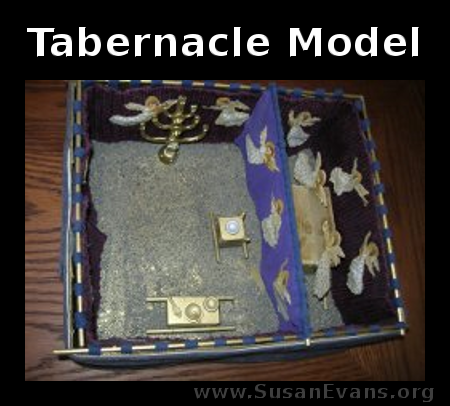
In this video, I show you how to make a Tabernacle model. You will need the following supplies:

  • a shoebox
  • pieces of cloth
  • wooden dowels
  • self-hardening modeling clay
  • a small wooden box
  • hot glue
  • gold spray paint
  • sand
  • white school glue
  • pictures or drawings of angels
  • small gold rings to slide dowels into
  • small wooden bowls (can be made from clay)

I give you directions on how to put it together in the video. I also explain why the Tabernacle is significant, and the modern equivalent of the Tabernacle today.

If you enjoyed making this Tabernacle model, you will love Using Simple Costumes and Props to Teach the Bible!

Who Knew Biology Was So Funny?

September 25th, 2012

biology-humor

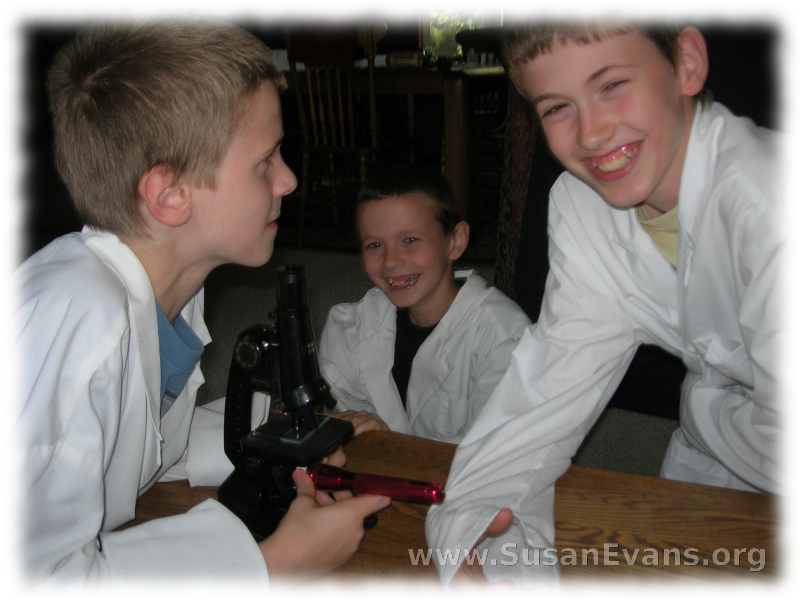
Biology humor is rampant in a homeschool that contains mostly boys. A few days before starting our Apologia Biology book, I wrote down the four criteria for life on a sheet of paper and taped it on the wall:

  1. “All life forms contain deoxyribonucleic acid, which is called DNA.
  2. All life forms have a method by which they extract energy from the surroundings and convert it into energy that sustains them.
  3. All life forms can sense changes in their surroundings and respond to those changes.
  4. All life forms reproduce.”

Without saying a word, my oldest two sons apparently looked at the page and learned it. On the day before starting biology, we were just finishing up dinner when I asked the children what makes something alive.

My 10-year-old son rattled off the four criteria for life word perfect, and my oldest son said the same thing in his own words.

“Nuclear acid?!” said my third son, giggling. “All living things have to have nuclear acid?!” Everyone started laughing.

“Deoxyribonucleic acid, you know, DNA.” I turned to my 7-year-old daughter and said, “Can you say ‘deoxyribonucleic acid’?”

“That word is too long,” stated my daughter matter-of-factly. So I broke the word down into syllables, and she said each syllable.

“What else do you think is necessary for something to be alive?” I asked the kids.

“All life forms must have boogers,” stated my third son, causing hilarity.

“But plants don’t have boogers, and plants are alive,” I stated calmly. The kids laughed so hard they nearly fell out of their chairs.