Posts Tagged ‘Homeschooling’

Teaching Geography with Coins

Monday, July 29th, 2013

Teaching-Geography-With-Coins

A fun way for kids to learn about the countries of the world is to look at coins from other countries and start their own coin collections. Teaching geography with coins is a great way to touch something from another country and to figure out what is important to that country.

Where can you find coins for your children?

  • From your own travels to different countries
  • From relatives or friends who have been to other countries
  • From people at your church who have returned from missions trips
  • From other homeschoolers who can swap coins with you
  • From coin collecting shops

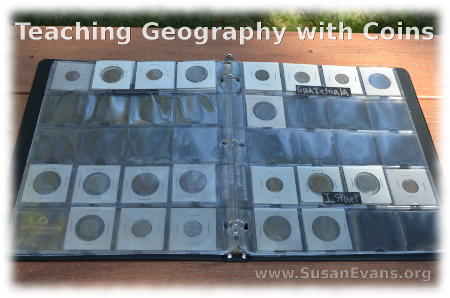
How do you start a coin collection? First you will need a 3-ring binder. Next you will want to purchase coin collecting pages, which are plastic pages with 20 square pouches on each page. You can buy these at a coin collecting shop. Look up “coin collecting” in your local yellow pages, or google “coin collecting” and your city. Most cities have a coin collecting store.
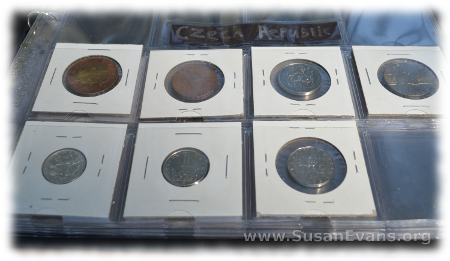
teaching-geography-with-coins-2Besides the binder and the plastic pages with pouches, you will want to get the cardboard squares that will hold the coin in place. You staple those shut with a special stapler that is smooth on both sides so that it doesn’t hurt the plastic. Label the countries with little slips of paper taped to the plastic sheets.

If you are dirt poor and don’t want to spend any money whatsoever, you can collect loose coins in a clear Ziplock bag to look at whenever you want. You can do rubbings of the coins by placing the coins under a sheet of paper, and rubbing crayon across the top. You can staple your coin rubbings together into a booklet. This is particularly good to do if you are only borrowing the coins from someone, and you need to give the coins back.

What can you learn from countries by looking at coins? These are some of the emblems we found on our coins from around the world, showing what is important to each country. These pictures might help you identify where your coins are from:

  • Canada–maple leaf, queen
  • Egypt–scorpion, map of Africa
  • France–woman in a dress, head of a woman
  • Germany–head of a man, woman planting, eagle
  • Greece–helmet of armor on a man, Parthenon
  • Guatemala–woman’s head with headband, tree, man’s head, stone monument, quetzal bird
  • Ireland–harp, bull, Celtic design
  • Israel–Dome of the Rock, top of a column, golden lampstand, fleur-de-lis, harp
  • Italy–woman’s head, Roman gods and goddesses
  • Mexico–eagle with snake in beak
  • Netherlands–crown, queen
  • Spain–men’s heads, shield, pillars, crown
  • United Kingdom–one king, all the rest queens, portcullis, crown, chains, Poseidon with trident, coat of arms, ship, lion with crown

These were just a few of the observations my children called out to me as they were examining the coins from their coin collections. Teaching geography with coins was a fun experience for my family!

For fun and easy ways to teach geography to your kids, watch Living Geography: Travel the World from your Living Room.
French Cafe for Kids

Monday, July 15th, 2013

french-cafe-for-kids

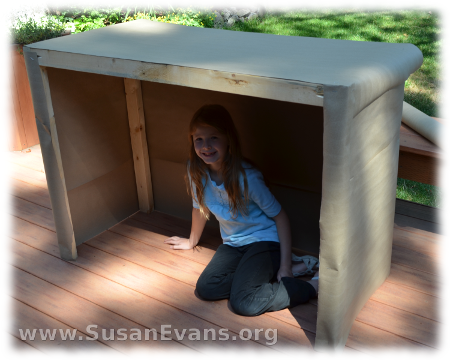
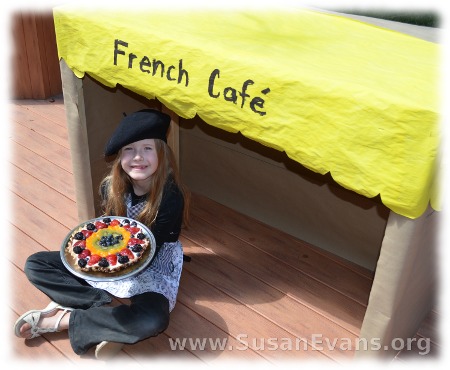
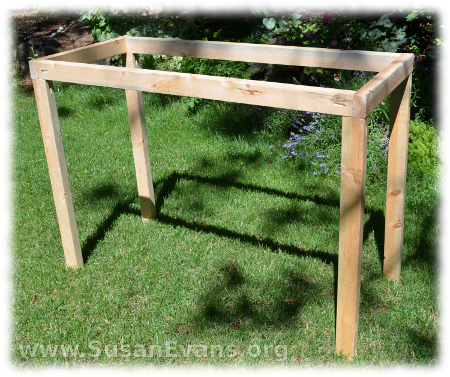
A fun activity to do with your kids when they are learning about France is to construct a simple French cafe for kids. You will need 8 two-by-fours screwed together to make a frame.

french-cafe-for-kids-2

Next you want to staple a roll of brown paper around the outer edge of the frame on three sides. Also make a paper ceiling.

french-cafe-for-kids-3

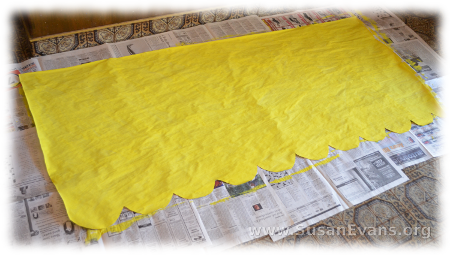
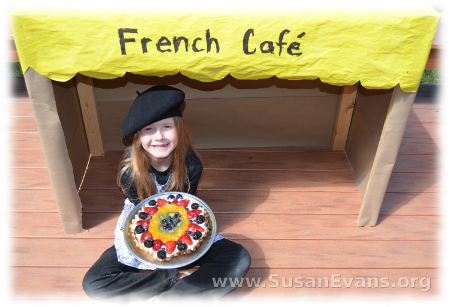
If you have a roll of colorful paper, you don’t have to paint it. We got a free roll of paper from the newspaper office, and we painted that yellow. We allowed it to dry for 3 hours. Then we cut waves into it, like the top fringe of a French cafe would look in Paris. We wrote “French Cafe” on the fringe with an extra thick black marker.

french-cafe-for-kids-4

Go ahead and staple that to the top of the wooden frame, and you have a finished cafe!

french-cafe-for-kids-5

Load up your cafe with French pasties and strong coffee. Set out small tables and chairs outside your cafe, and serve your friends while listening to French music playing in the background. Bon Apetit!

More great ideas for teaching geography: Living Geography: Travel the World from your Living Room

Don’t miss any of my fun posts! Subscribe to my blog and like me on Facebook.

Growing Your Home Library Without Breaking Your Budget

Monday, June 3rd, 2013

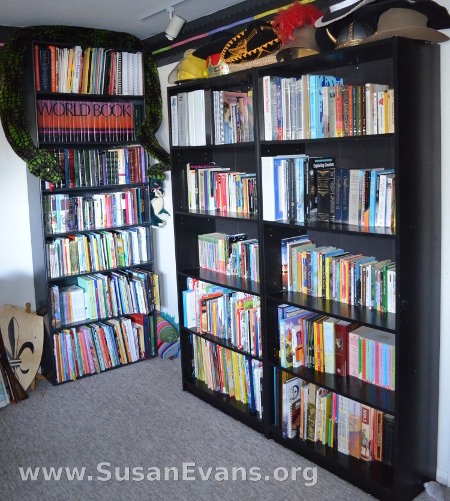
home-libraryI bet you’re wondering how I grew my home library to over 2,000 outstanding, high-quality books without spending hardly any money. I myself sometimes marvel at how God has provided over the years.

When planning my homeschooling for the upcoming school year, I always start by committing the year to God and asking Him what areas to study. We go through history chronologically, but all the other subjects besides math are delight-directed until high school, depending on what we haven’t studied yet.

Anyone who has done unit studies successfully is able to pull together lots of fun books on one topic. You can do this by going to the library, but I prefer to own the books so that they are always available to me. (I like to preview all the books as well, and only have the very best.) When I write down what topics we will cover for the following school year, the books practically pop out at me wherever I look. Here are my favorite places to find books:

  • yard sales
  • second-hand stores
  • used book stores
  • used books on Amazon
  • Craig’s List
  • library book sales
  • used curriculum sales
  • gifts from friends or family

Back when I first got married, I didn’t have the basic Bible study tools like a concordance, Bible dictionary, handbook about Bible times, maps and charts, etc. I asked myself who would feel joy if I studied the Word of God? My parents decided to get me the whole set, which was on sale, for Christmas. Our whole family is closer to God now because we have proper Bible study tools, and the credit goes to my parents. I have no doubt they will be rewarded in heaven. That set of books was not cheap, even at 50% off. What I’m saying is that if people are going to buy your family Christmas presents anyway, make known specific books that you can’t wait to purchase.

After getting the bulk of my books at yard sales and second-hand stores, can you believe that I actually made money off books, and I could buy whatever I wanted—even new books—from my list? I know you’re eagerly waiting on the edge of your seat for my secret, so here it is: I buy hardcover children’s classics and coffee table books at yard sales for fifty cents. Then I turn around with a large stack of almost-free books that look new, and I trade them in to a used book store. My used book store also sells new books, and I often get a trade-in value of $80! I do this in the summer when yard sales are in profusion. I never buy children’s books that are from a book club, because they are worthless. I’ve learned over the years which books have higher trade-in value, and which ones get rejected. But with practically no money, I’ve acquired over 2,000 outstanding, high-quality books for my home library that my family uses profusely in our homeschooling.

Growing a Sweet Potato in Water

Monday, May 27th, 2013

growing-a-sweet-potato-in-water

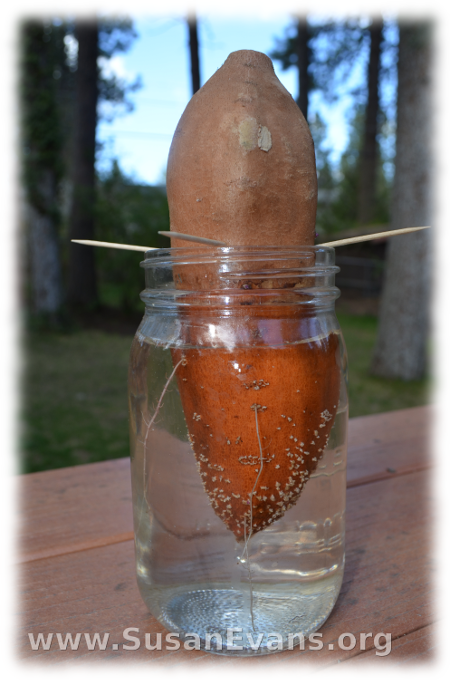
Growing a sweet potato in water is a great way to see plant roots growing. You will need a sweet potato, a jar, water, and four toothpicks.

You will want to dip the sweet potato into the water about a third of the way down. Stab the toothpicks into the potato to keep it in place. Fill the jar with water. Now watch the roots grow right in front of your very eyes.

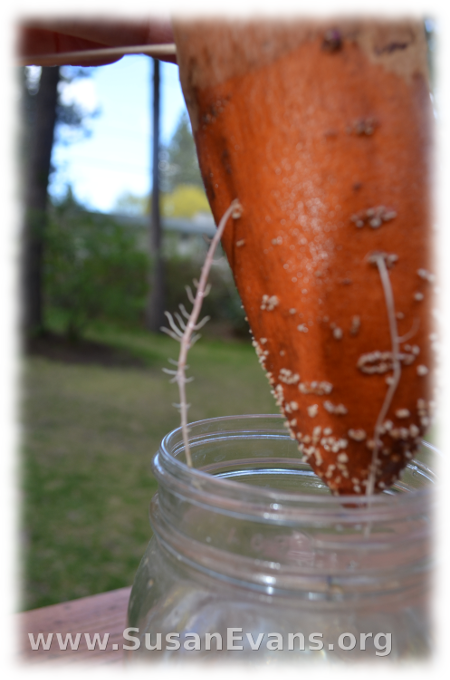
First you will see stubble, like a man who hasn’t shaved in a couple of days. This happens within the first few days. Then a few of the roots grow longer, branching out with root hairs. Since the jar is clear, you can see all this happening.

Other people buy expensive kits that have glass walls on either side so that you can see the roots of carrots and radishes growing, but the dirt is still in the way. With growing a sweet potato in water, you can see the root developing without any dirt in the way, and it doesn’t cost a lot.

growing-a-sweet-potato-in-water-2In biology this year, we studied the sections of a root, looking at the root under a microscope. The children were fascinated when they looked at prepared slides of monocot and dicot roots, which apparently have a different structure. Monocot roots have a circle shape in the middle, whereas dicots have an X shape.

The main way to know if a plant is monocot or dicot is to look at its leaves. If the leaves are straight up and down like leaves of grass, it’s a monocot. If the leaf has veins branching out, it’s a dicot.

You can see all the other activities we did in biology this year in the Unit Study Treasure Vault.

Linked to Laugh and Learn